Registered NDIS provider · Reg ID 4-JCLD6XENurse-led complex & clinical careServicing Sydney & PerthEnquiries answered same business dayRegistered NDIS provider · Reg ID 4-JCLD6XENurse-led complex & clinical careServicing Sydney & PerthEnquiries answered same business day
Nursing and clinical routines done at home, so fewer days are spent travelling to clinics.
For many people in Liverpool with complex needs, care means a calendar of clinic visits: the wound clinic, the catheter change, the review. Abundance Healthcare Group moves as much of that as is safe into the home, with a registered nurse doing the clinical work and trained workers carrying the routine between visits.
What it is
Clinical NDIS care for people living in Liverpool
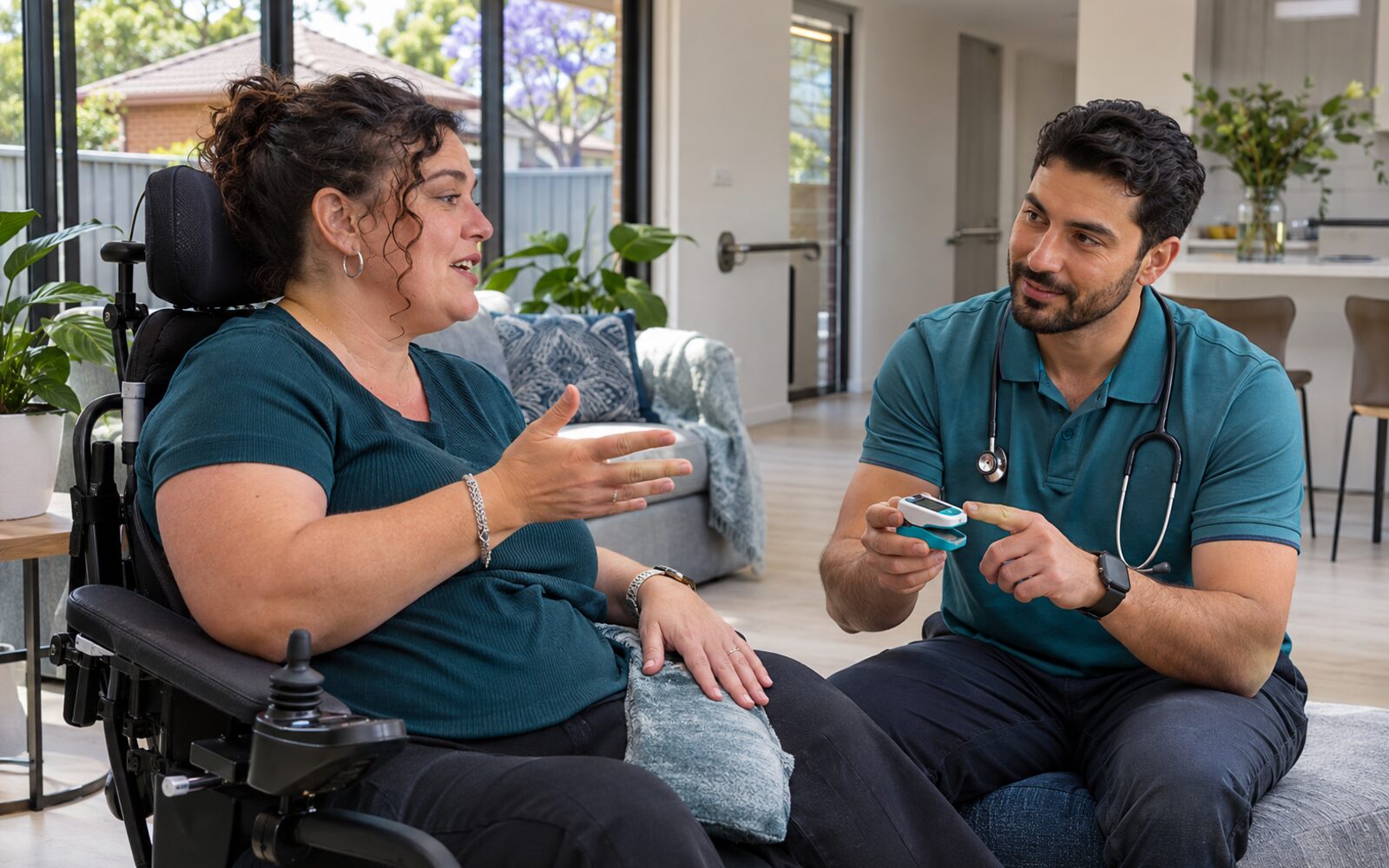
We provide clinical care at home for NDIS participants in Liverpool: wound dressings, catheter changes, PEG care, bowel care and medication support. A registered nurse assesses, writes the plan and returns for the tasks that need a nurse, while trained workers handle the daily routine.
People comparing NDIS providers in Liverpool often ask whether a provider has its own nurses. We do, and they visit homes. Liverpool disability services vary a great deal in how clinical they are, so it is worth asking any provider who writes the care plan. This page belongs to our wider South West Sydney disability services.
What we deliver
Four kinds of support, one Liverpool team
Liverpool participants can draw on four supports from the same team: high intensity daily personal activities, community nursing, daily personal care, and community access and transport. Using one team means the nurse who writes the plan also supervises the people who follow it.
High intensity daily personal activities
Workers trained in high intensity supports give PEG feeds, carry out bowel care and manage catheters day to day, following written steps and stop points.
Community nursing at home
Through community nursing a registered nurse comes to the home for the tasks that would otherwise mean a clinic appointment, and for regular plan reviews.
Daily personal care
Help to shower, dress, move and eat, at the times that suit the person. For someone recovering from a brain injury, the same worker and the same sequence each morning make a real difference.
Community access and transport
Getting to Liverpool Hospital outpatients, Westfield, the library, Bigge Park or relatives nearby, with a worker who can drive or come along on the train.
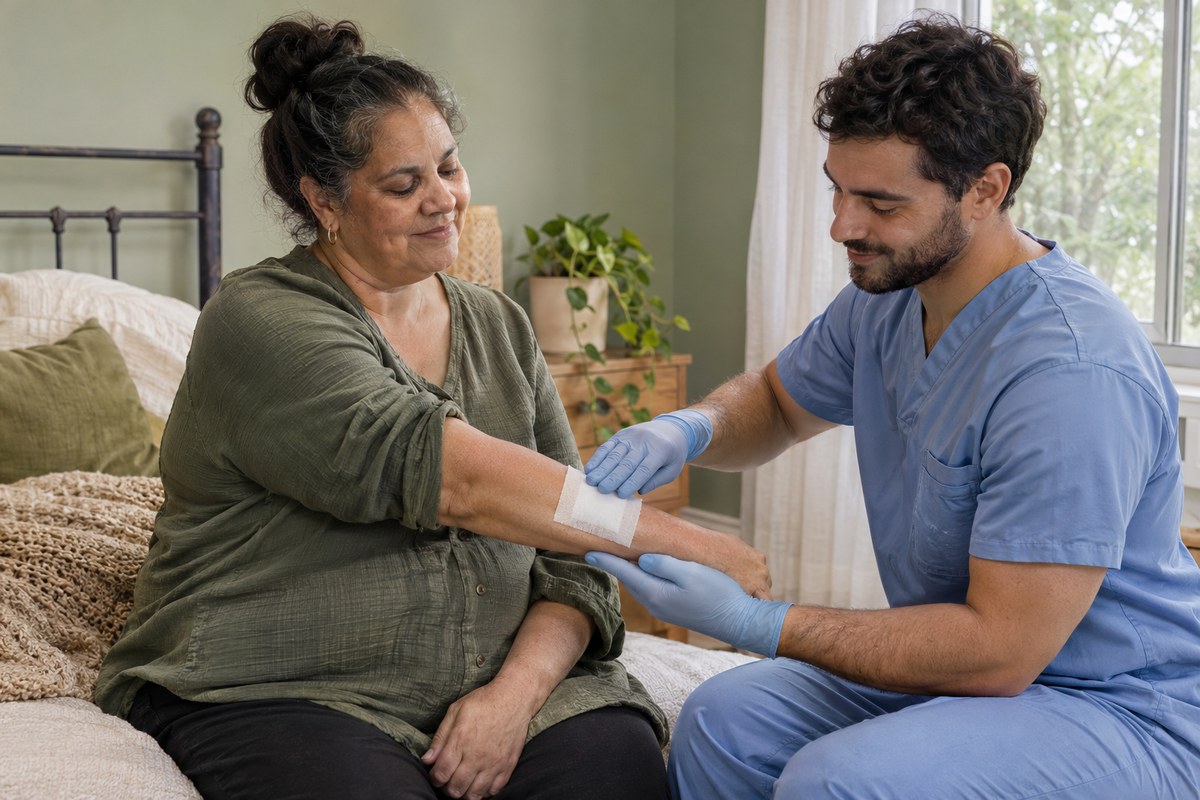
A dressing changed at home saves a half day of travel and waiting.
Local support
After Liverpool Hospital or brain injury rehabilitation
Liverpool Hospital is the largest hospital in the south west and has a brain injury rehabilitation unit. People leaving either often come home with new routines: medication at set times, prompts for memory, a feeding tube, or help to transfer safely. We prepare plans before discharge.
Our approach to acquired brain injury support is built around consistency: few workers, a fixed routine and written cues the whole team uses. The hospital and the unit are named for geography. We accept referrals from their staff and have no formal arrangement with either.
What it is
What can be done at home instead of a clinic?
Much routine clinical care can be done at home by a nurse, provided the task does not need imaging, a procedure room or a doctor on the spot. The table sets out common tasks, what we do at home and when a clinic visit is still the right choice.
Care task
At home with us
When a clinic is still needed
Pressure injury or chronic wound dressing
Nurse dresses, measures and reviews seating and bedding
Surgical review, debridement or specialist wound assessment
Catheter change
Nurse changes it on the scheduled day
A difficult change, or problems needing a urologist
PEG care
Site checks, feeding plan review and troubleshooting
Tube replacement or anything involving sedation
Bowel care
Carried out daily to the nurse's plan
Investigation of a new problem
Medication a nurse must give
Given at home at the right time
Infusions and anything needing monitoring equipment
Review after a hospital stay
Nurse checks the discharge plan against real life at home
Specialist follow-up appointments
Funding
Costs for Liverpool participants
Supports are charged to the NDIS plan within the NDIA's pricing schedule, and the participant is not billed a gap. Nursing is funded when the need is ongoing and caused by the disability. Clinic and hospital care continues to be covered by Medicare and the public health system.
The two systems run side by side. Using the NDIS in Liverpool does not replace your GP or specialist, and our nurse works to their orders. The service agreement names each support item and any travel before the first visit.
Timing
Starting in Liverpool: what we need from you
To start, we need the suburb, the clinical tasks and how often each is done, the current orders or care plans, and how the plan is managed. With those, we can answer on capacity within one business day and book the nursing assessment.
Paperwork. Discharge summary, medication list and any orders from the GP or specialist.
Home visit. The nurse meets the participant and works out which clinic tasks can move home.
First visits. Nursing tasks begin, and workers are trained on the daily routine.
Who delivers it
The nurse behind your plan
One registered nurse is responsible for each participant's plans. That nurse assesses, writes the steps, trains the workers, reviews the care and speaks to the GP when something changes. Their registration can be checked on the AHPRA register, and ours on the NDIS Commission's provider register.
Our Registration ID is 4-JCLD6XE. Workers hold an NDIS Worker Screening clearance, incidents are recorded and reviewed, and concerns can be raised with us or with the Commission.
Local support
Recent support in Liverpool
Snapshots of nursing and daily support in Liverpool homes. We ask before taking any photo, record the consent in writing and remove details that would give away a name or a street.
Where we work
Casula to Chipping Norton: suburbs covered
We take referrals across Liverpool City, including Liverpool, Warwick Farm, Casula, Moorebank, Chipping Norton, Lurnea, Prestons, Hoxton Park, Green Valley, Hinchinbrook, Miller, Cartwright, Wattle Grove, Holsworthy and Edmondson Park. Liverpool is a short drive from our Campbelltown office.
North of the council boundary we also support people in nearby Fairfield.
Common questions
Liverpool NDIS questions
Can you support someone leaving the Liverpool brain injury unit?
Yes. We take referrals for people going home from brain injury rehabilitation. A nurse reviews the discharge plan, and we keep the team small and the routine fixed, which is what usually helps most in the first months.
Do you cover Green Valley and Hoxton Park?
Yes. Both are in Liverpool City and inside our service area. They are an easy drive from our office, so staffing is generally simpler than in more distant parts of Sydney.
Can wound care be done at home?
Usually, yes. A registered nurse can assess, dress and monitor most chronic wounds at home and review the seating or mattress behind them. Wounds needing surgical review or debridement still go to a clinic.
How soon can you start?
Liverpool is close to our office, which helps. You get a realistic date within one business day. The nurse can usually start visiting before the workers, who need training on the plan first.
Do you have Arabic or Vietnamese speaking workers?
Possibly. Language matching depends on who is on the team at the time, so we check when you enquire instead of publishing a list. Where no match is available, an interpreter is used for anything involving consent or the care plan.
Can you attend Liverpool Hospital appointments with me?
Yes. A support worker can travel with you, wait, take notes with your consent and bring you home. It is booked as a normal shift and funded from the plan.
Want clinical care at home in Liverpool?
List the clinic visits you would like moved home and the suburb you live in. A reply follows within one business day.