Registered NDIS provider · Reg ID 4-JCLD6XENurse-led complex & clinical careServicing Sydney & PerthEnquiries answered same business dayRegistered NDIS provider · Reg ID 4-JCLD6XENurse-led complex & clinical careServicing Sydney & PerthEnquiries answered same business day
For MND Coordinators: A Care Provider That Scales with Progression
Motor neurone disease does not wait for a roster to catch up.
An MND care provider has to add support almost as fast as the disease takes function away. Abundance Healthcare Group is a nurse-led NDIS provider in Sydney and Perth that adds personal care, PEG feeding and longer hours as needs change, and is open about the point where respiratory care goes beyond what we offer.
What it is
Why MND referrals need a provider that can scale
MND can change what a person needs within months, and sometimes within weeks. A provider that can only deliver the roster agreed at the start leaves the family and the MND coordinator filling gaps. A provider that can scale adds hours, tasks and nursing as each change arrives, without the person having to start again elsewhere.
Starting again has a cost. New workers have to learn how the person communicates, how they are positioned and what they will not tolerate. A change of provider at that stage is hard on the person and on the family. Keeping the same team and widening what it does avoids it.
For the participant's side of this, including how personal care and mealtimes are handled, see our page on MND support at home.
What it is
Supports we add as needs progress
We add supports as each change arrives. A common sequence is help with personal care and transfers, then mealtime support, then PEG feeding and nursing, then longer shifts, though the order differs from person to person. The table shows each change, what we add and what decides the timing.
Change in the person
Support we add
Lead time depends on
Weaker arms or legs, more falls
Personal care, transfers and hoist use
Workers free in the suburb
Speech harder to understand
Workers briefed on the communication device and the person's own signals
Access to the speech pathologist's guidance
Coughing or choking at meals
Mealtime support to the speech pathologist's plan
A current mealtime plan
PEG inserted
PEG feeding, site care and nursing review
Nursing assessment and worker sign-off
Constipation or bowel routine needed
Bowel care to a nurse-written plan
Nursing assessment and orders
Carer exhausted, nights unsafe
Longer shifts or overnight support
Confirmed case by case
Non-invasive ventilation started
We do not provide ventilator support
A ventilation-capable provider is needed for those tasks
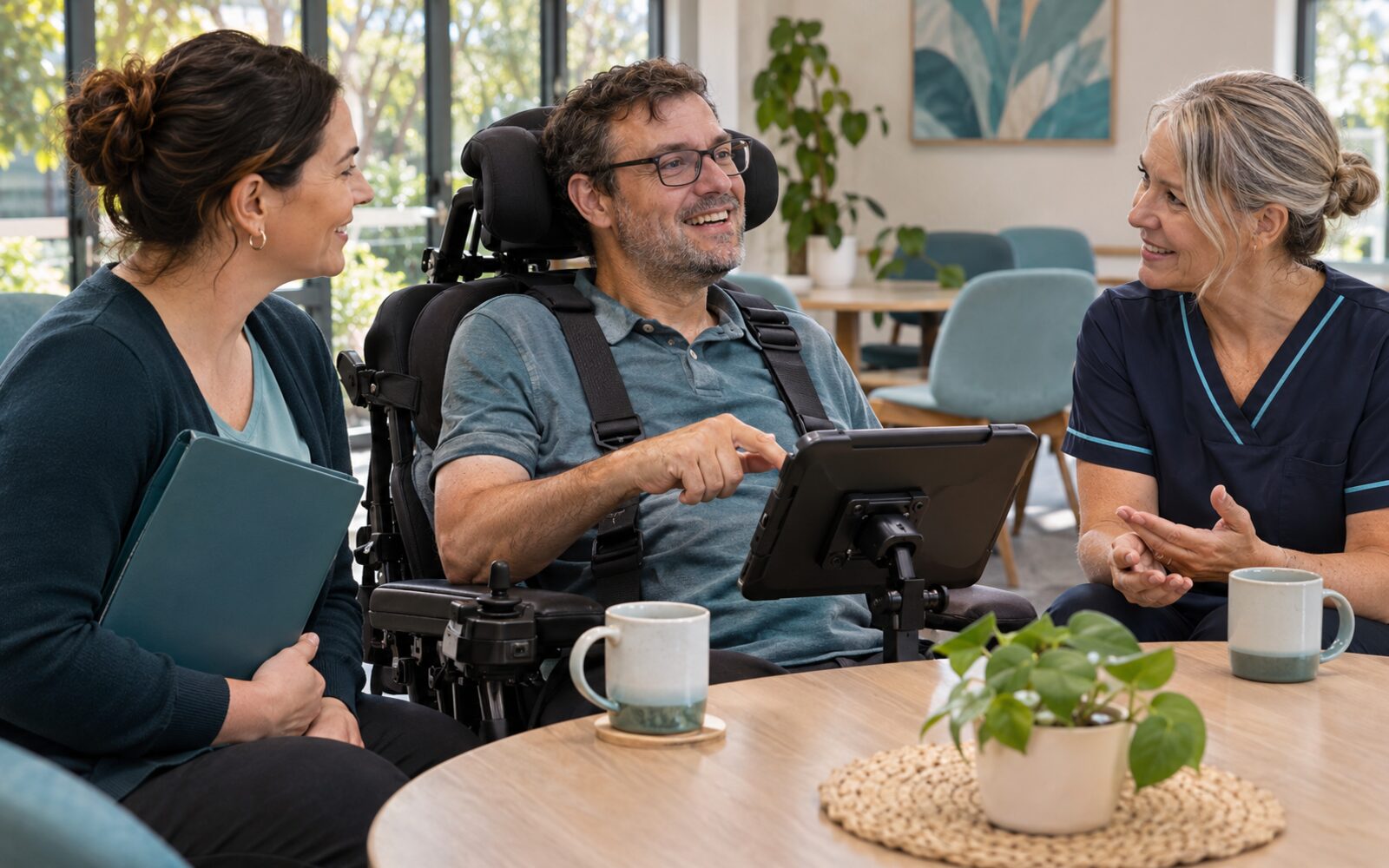
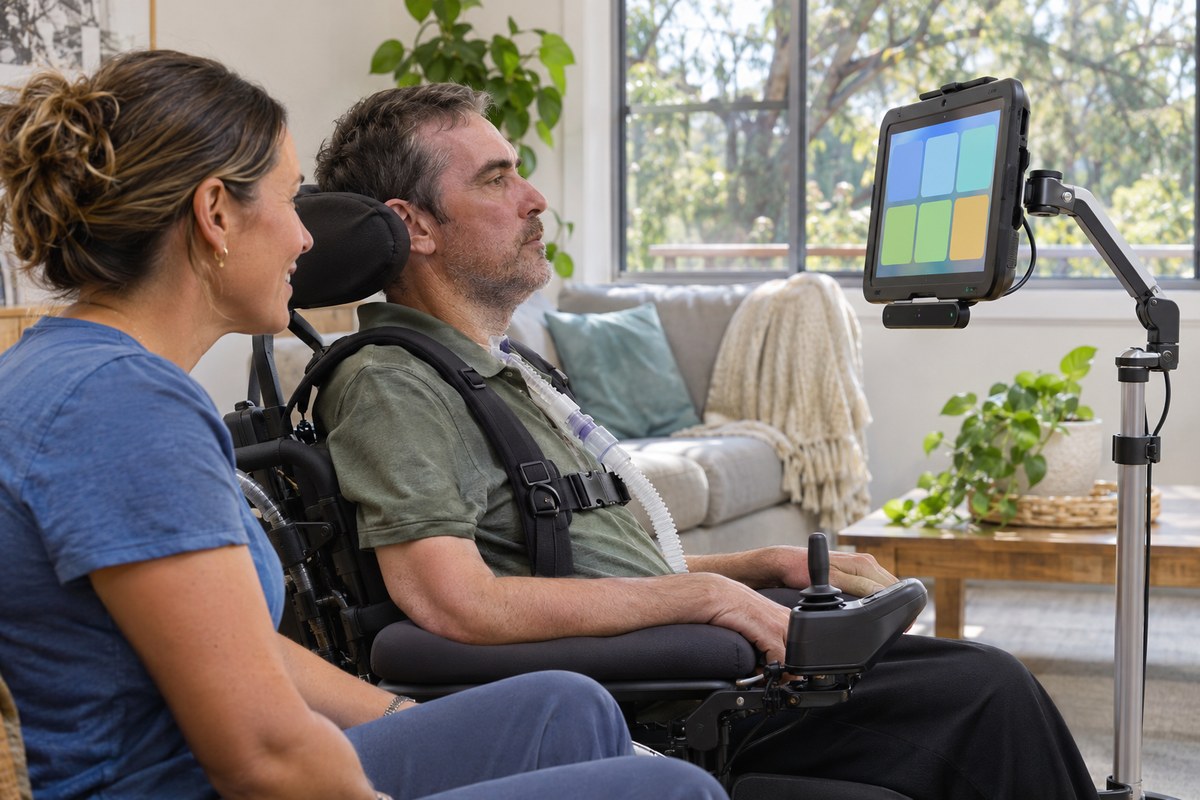
Workers learn each person's communication method before the first shift.
Timing
Response times for urgent changes
We reply to a request for more support within one business day. Extra hours from workers who already know the person are the quickest change to make. A new clinical task takes longer, because a nurse must assess and the workers must be trained on it first.
Telling us early helps more than anything. If the respiratory clinic or speech pathologist has said a change is coming, such as a PEG in the next few months, we can assess and train ahead of it.
Reviews
Communication with advisors, clinics and families
With the person's consent, we keep the MND advisor, the multidisciplinary clinic and the family informed through one channel: the nurse responsible for the care plans. That nurse sends an update after each review and makes contact between reviews when a change is seen at home.
At referral. We ask who is involved: neurologist, MND clinic, palliative care, speech pathologist, occupational therapist and GP.
At each review. The nurse sends a short written update on what is being delivered and what has changed.
Between reviews. Workers report changes in swallowing, breathing, weight or mood to the nurse, who passes them on to the right clinician.
Safeguards
Respiratory and swallowing risk: our limits
We manage swallowing risk and we do not manage ventilation. Our workers provide severe dysphagia support and PEG feeding to written plans. We do not provide ventilator support, including non-invasive ventilation, or tracheostomy care. When breathing support begins, another provider must cover those tasks.
This matters for planning. If a person is likely to start non-invasive ventilation, raise it at referral. We will tell you which supports we can keep delivering alongside a ventilation-capable provider, and when a full handover would be safer for the person.
Workers are taught the signs of respiratory decline, such as morning headaches, breathlessness lying flat and a weaker cough, and they report them to the nurse the same day. Emergencies go to triple zero, in line with the person's advance care plan.
Funding
Funding pathways under and over 65
Age at the time of applying decides the funding system. A person who applies to the NDIS before turning 65 can become a participant and can stay on the scheme after 65. A person who is already 65 or over when they apply is supported through aged care, which since November 2025 means the Support at Home program.
Our services are set up for NDIS participants. For NDIS plans, MND usually calls for regular reassessment as needs rise, and our review updates are written to support those requests. If the person is funded through aged care, contact us before referring and we will tell you plainly whether we can help.
The state MND associations, MND NSW and MNDAWA, offer advice and information to both groups. We have no formal arrangement with either.
Who delivers it
Team training for MND
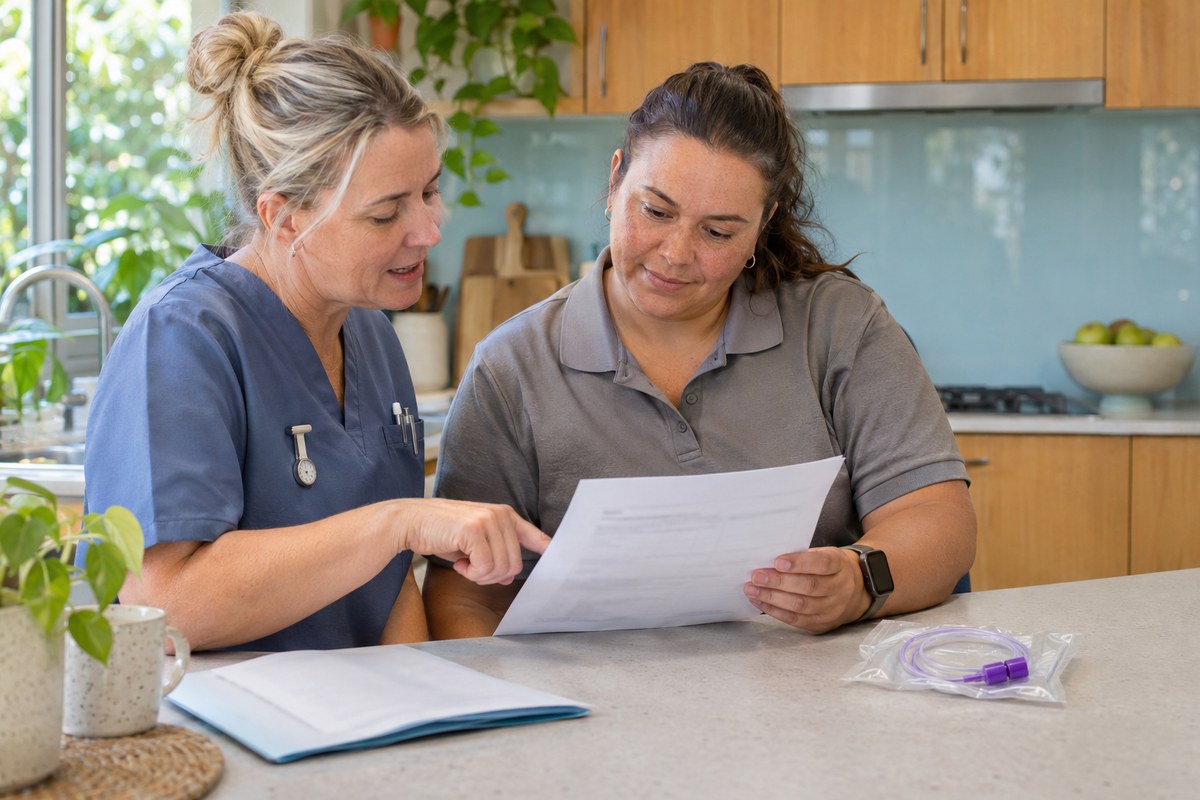
Workers are trained on the individual, not on MND in general. A nurse trains them in the person's PEG routine, mealtime plan, positioning, hoist transfers and communication method, observes them doing each task and signs them off. Competency for high intensity tasks is reviewed every year.
That follows the NDIS Commission's skills descriptors for high intensity supports, which require training from a qualified health practitioner. When the person's needs change, the affected plans are rewritten and workers are retrained on the new version before they use it.
When a plan changes, workers are retrained before they use the new version.
Where we work
Referral coverage for MND
We accept MND referrals for people living in Greater Sydney and the Perth metropolitan area. Capacity depends on the suburb and the hours, and it matters more than usual with MND because the roster is likely to grow. We tell you at the start how much growth we can staff.
To begin, refer a participant with the current supports, the clinicians involved and the changes you expect over the next few months.
Common questions
MND coordinator questions
Can you increase hours within days?
Sometimes. Extra hours from workers who already know the person can often be arranged quickly. Hours that need new workers take longer, because each worker is trained on the person's plans first. We reply within one business day with what is possible.
Do you support non invasive ventilation?
No. We do not provide ventilator support, including non-invasive ventilation, or tracheostomy care. We can continue personal care, PEG feeding and nursing alongside a provider that covers ventilation, if that arrangement is safe for the person.
Do you provide care for people funded through aged care?
Our services are set up for NDIS participants. If the person is funded through aged care, contact us before referring and we will say plainly whether we can help or suggest who to ask.
Who is our single contact?
The registered nurse responsible for the person's care plans. You are given that nurse's name when the service starts, and review updates and changes at home come to you from them.
Can you provide overnight care?
Overnight support is confirmed case by case. It depends on the hours funded, the tasks needed overnight and whether trained workers are free in that suburb. Ask early, because overnight rosters take the longest to build.
How do you train workers for MND?
A nurse trains each worker on the person's own plans: PEG feeding, mealtime support, transfers and communication. The nurse observes the worker and signs them off before they work alone, and repeats the training whenever a plan changes.
Supporting someone whose needs are changing fast?
Send the current supports, the next likely change and the suburb. We reply within one business day with what we can add and when.