Registered NDIS provider · Reg ID 4-JCLD6XENurse-led complex & clinical careServicing Sydney & PerthEnquiries answered same business dayRegistered NDIS provider · Reg ID 4-JCLD6XENurse-led complex & clinical careServicing Sydney & PerthEnquiries answered same business day
Clinical personal care at home, delivered by trained workers and overseen by registered nurses.
High intensity daily personal activities are the personal care tasks that carry clinical risk, such as bowel care, tube feeding and catheter care. Abundance Healthcare Group delivers them in Sydney and Perth under registration group 0104, with a registered nurse behind every care plan.
What it is
What high intensity daily personal activities are
High intensity daily personal activities are NDIS personal care supports that need extra skill because a mistake could cause harm. The NDIS Quality and Safeguards Commission sets them out in a dedicated practice standards module, and a provider must be registered for group 0104, Assist Personal Activities High, to deliver them as a registered provider.
You will see this support written several ways. Planners and coordinators often shorten it to HIDPA, and an NDIS plan or service agreement may simply say high intensity supports. They all describe the same thing: help with a daily personal task where the worker needs training that is specific to the task and to the person.
The difference from everyday personal care is risk, not effort. Showering or dressing someone safely takes skill, yet a trained support worker can learn it in general training. Managing a feeding tube or a bowel care routine needs a plan written by a health professional, training on that plan and someone checking that the worker is still competent.
What we deliver
The high intensity supports we deliver
We deliver six high intensity supports: complex bowel care, enteral feeding and PEG care, urinary catheter care, subcutaneous injections, complex wound care and severe dysphagia support. Each one is delivered by a support worker trained for that task and that participant, under a plan a registered nurse has written.
The six supports below are the ones we are set up to deliver today. We do not currently take on tracheostomy or ventilator support, and we would rather tell you that at the start than part way through a referral. You can read the full list of clinical tasks we cover on our capabilities page.
Complex bowel care
A bowel care plan may include enemas, suppositories or digital stimulation on a set routine. Workers follow the written plan, record each result and report changes such as pain, bleeding or a missed routine to the nurse on the same day.
Enteral feeding and PEG care
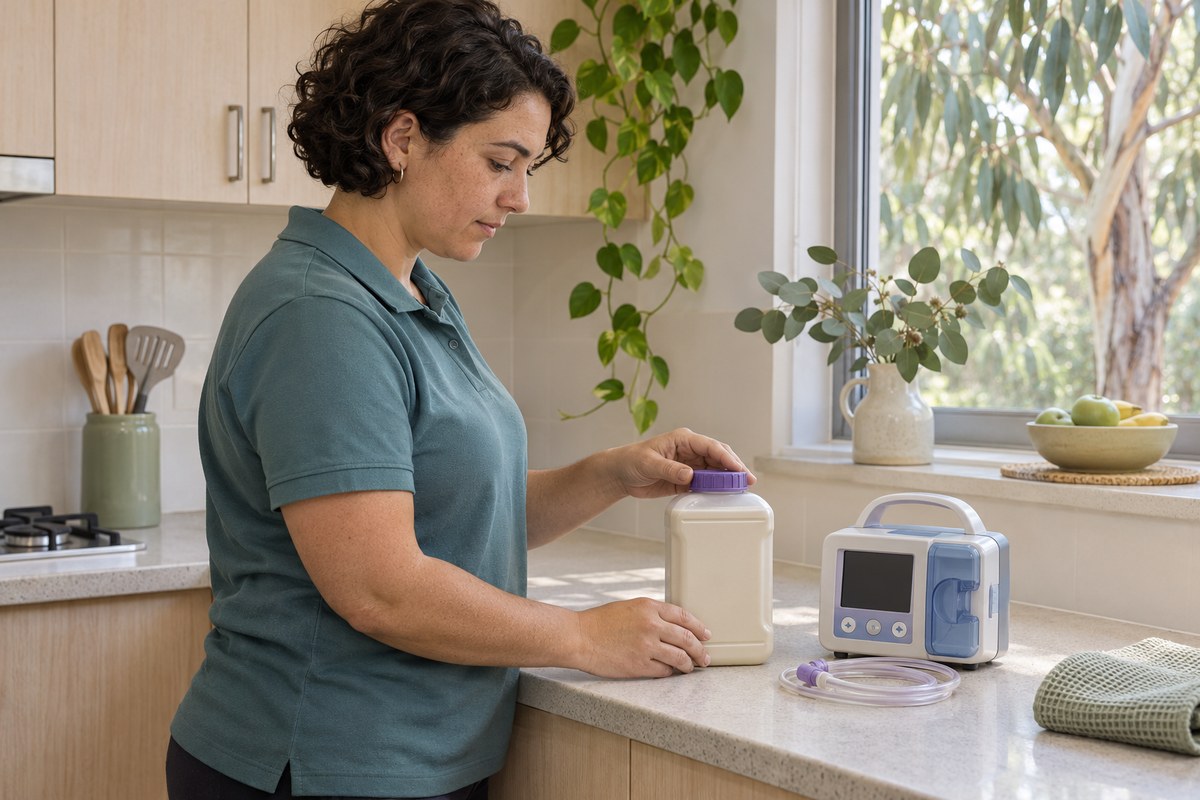
Workers give feeds, water flushes and prescribed medication through a PEG or other feeding tube, look after the stoma site and know what to do if the tube blocks or comes out. The feeding regime itself is set by the dietitian or treating team.
Urinary catheter care
This covers daily care of an indwelling or suprapubic catheter, emptying and changing drainage bags, and watching for signs of infection or blockage. Catheter changes are done by a nurse, not a support worker.
Subcutaneous injections
Workers give injections that have been prescribed and set up for them, most often insulin as part of a diabetes management plan. They check the dose against the plan, rotate sites and record every injection.
Complex wound care
Support workers help with pressure injury prevention: repositioning, skin checks and using pressure relieving equipment as planned. The wound itself is assessed and dressed by a nurse, who decides what a worker may and may not do between visits.
Severe dysphagia support
For a participant who has serious difficulty swallowing, workers prepare food and fluids to the texture in the mealtime plan, position the person correctly, pace the meal and respond to coughing or choking in the way the plan sets out.
Feeds, flushes and site care follow the written plan for each participant.
What it is
High intensity support or community nursing: which applies?
High intensity support is delivered by a trained support worker following a nurse's plan. Community nursing is delivered by the nurse. Many participants need both: the nurse assesses, plans, trains and handles the tasks only a nurse may do, and trained workers carry out the daily routine in between.
High intensity daily personal activities
Community nursing care
Who delivers it
Support worker trained for the task and the participant
Registered or enrolled nurse
What it covers
The daily clinical routine: bowel care, tube feeds, catheter care, set injections, mealtime support
Assessment, care planning, wound dressings, catheter changes, training and review
Registration group
0104 Assist Personal Activities High
0114 Community Nursing Care
How it is funded
Usually Core Supports, Assistance with Daily Life, at the high intensity price limit
Usually Core Supports as a disability-related health support, at the nursing price limit
When it suits
The task is stable, planned and repeated every day
The task needs clinical judgement or changes from visit to visit
Because we are registered for both groups, one team can cover the plan. Our community nursing care page explains what the nurse does on a visit.
Who delivers it
Who delivers high intensity support, and how they are trained
High intensity support is delivered by disability support workers, not nurses. What makes it safe is the structure around them: a registered nurse assesses the participant and writes the plan, each worker is trained on that plan, and competency is checked before the first shift and again at set intervals.
Registered nurse assessment and care plan
Before any high intensity shift, a registered nurse meets the participant, reads the discharge summary or treating team's instructions and writes a support plan for each clinical task. The plan says what to do, what normal looks like and exactly when to call the nurse or an ambulance.
Task specific training and competency sign off
Each worker is trained on the task and then on the participant's own plan, and is observed doing it correctly before working alone. The Commission's high intensity support skills descriptors recommend reviewing competency every year, and again if a worker has not delivered the support for three months or the plan changes. We follow that guidance.
A nurse signs off each worker on each task before they work alone.
Funding
How high intensity supports are funded in an NDIS plan
High intensity support at home is usually paid from the Core Supports budget, under Assistance with Daily Life. The NDIA sets a higher price limit for it than for standard personal care. We charge within the current NDIS pricing schedule, and the hourly limit varies with the day and time of the shift.
A plan does not have to use the words "high intensity" for the support to be claimable, but the evidence does need to show that the task requires extra skill. If you are trying to work out how the NDIS funds high intensity support, the short answer is that it is a price level inside an existing budget, not a separate budget. Where the funding is too low for the hours required, the coordinator can ask for a plan reassessment with the nurse's assessment as evidence.
We do not publish dollar figures because the limits change each year. Your service agreement lists every support item and its rate before the first shift.
Timing
How soon support can start
For a stable participant with a current care plan, we can usually confirm capacity within one business day and start once workers are trained on the plan. Start times are longer when a new plan must be written, when two workers are needed, or when shifts are overnight.
We give a straight answer on capacity. Overnight and round the clock rosters are confirmed case by case, because they depend on having enough trained workers near the participant's home. If we cannot staff a roster safely, we say so.
How it works
What happens from referral to first shift
A referral moves through five steps: we review the information, a nurse assesses the participant, the plan and service agreement are written, workers are trained on the plan, and the first shift runs with a nurse available by phone. Nothing clinical starts before the plan is signed off.
Referral. A coordinator, discharge planner or family member can send a referral with the plan dates, the supports needed and any clinical documents.
Capacity answer. We reply within one business day to say whether we can take the referral and what the likely start date is.
Nurse assessment. A registered nurse visits at home or in hospital and writes the support plans.
Service agreement and training. You approve the roster and rates, and each worker is trained and signed off.
First shifts. Early shifts are followed up by the nurse, and the plan is adjusted if something is not working.
Safeguards
Safeguards: incidents, changes in condition and complaints
Every high intensity plan includes written escalation steps, so a worker knows when to call the nurse, the treating team or triple zero. Incidents are recorded and reviewed, reportable incidents go to the NDIS Commission as the law requires, and complaints can be made to us or directly to the Commission.
People with progressive conditions change quickly. Our support for motor neurone disease is built around that: plans are rewritten as swallowing, breathing and mobility change, not left until the next scheduled review.
Reviews
Reviewing the plan as needs change
Support plans are reviewed by the nurse at set intervals and whenever something changes, such as a hospital admission, a new medication or a different feeding regime. Workers are retrained on the new plan before they use it, and the coordinator receives a written update.
Reviews matter most after a major change in function. With spinal cord injury support, for example, bowel and catheter routines set in rehabilitation often need adjusting in the first months at home.
Where we work
Where we provide high intensity support
We provide high intensity support in participants' homes across Greater Sydney and the Perth metropolitan area. Our office is in Campbelltown, and Sydney rosters run across Western Sydney, South West Sydney, the Macarthur region, St George and the Sutherland Shire, the Inner West, the east and the north.
We take referrals from across the west and south west, including families in Blacktown and Bankstown households. Tell us the suburb and we will confirm whether trained workers are available there.
Common questions
High intensity support questions
What counts as a high intensity daily personal activity?
A daily personal care task that carries clinical risk and needs task specific training. The NDIS Commission's module covers complex bowel care, enteral feeding, severe dysphagia, tracheostomy care, urinary catheters, ventilation, subcutaneous injections and complex wound care.
Who can deliver high intensity supports under the NDIS?
A registered provider must be registered for group 0104, and each worker must be trained and assessed as competent for the specific task and participant. The plan the worker follows must be written by an appropriately qualified health professional, usually a registered nurse.
How is high intensity support different from standard personal care?
Standard personal care covers showering, dressing, toileting and meals. High intensity support adds tasks with clinical risk, such as tube feeding or bowel care, which need a written health plan, task specific training and ongoing competency checks. The same worker often does both in one shift.
Is high intensity support charged at a different rate?
Yes. The NDIA sets a higher price limit for high intensity support than for standard support, because the worker needs more skill and supervision. We charge within the current NDIS pricing schedule, and the rate for each shift is listed in your service agreement.
Can you provide high intensity support overnight?
Sometimes. Overnight and round the clock rosters are confirmed case by case, because they depend on how many trained workers we have near the participant's home. We tell you within one business day whether we can staff the hours safely.
How quickly can you start with a new participant?
We answer on capacity within one business day. The start date then depends on the nurse's assessment, the service agreement and worker training. A stable participant with a current plan starts sooner than someone leaving hospital with new clinical needs.
What training do your support workers have?
Every worker completes general disability support training, then task specific training for each high intensity care task in a participant's NDIS plan, then training on that person's own routine. A registered nurse observes and signs off each worker before they work alone.
What happens if a participant's condition changes?
The worker follows the escalation steps in the plan and contacts the nurse. The nurse reviews the participant, updates the plan if needed, retrains workers on any change and lets the coordinator and family know what was done.
Need high intensity support at home?
Send the clinical detail and the hours required. A registered nurse reviews it and we reply within one business day with a clear answer on capacity.