Registered NDIS provider · Reg ID 4-JCLD6XENurse-led complex & clinical careServicing Sydney & PerthEnquiries answered same business dayRegistered NDIS provider · Reg ID 4-JCLD6XENurse-led complex & clinical careServicing Sydney & PerthEnquiries answered same business day
A registered nurse at your home for the clinical care your disability makes necessary.
NDIS community nursing care brings a nurse to the participant's home for wound care, catheter changes, tube feeding, continence care and medication support. Abundance Healthcare Group provides it in Sydney and Perth, and the same nurses train and oversee the support workers on the roster.
What it is
What NDIS community nursing care covers
NDIS community nursing care is clinical care from a nurse, delivered at home, for health needs that exist because of a person's disability. It covers assessment, hands-on nursing tasks, care plans and training for support workers. It does not replace the hospital, the GP or treatment of an illness.
The NDIS has funded disability-related health supports since October 2019. The test is whether the need is ongoing and comes from the disability. A pressure injury in someone with paraplegia, a feeding tube after a brain injury, or a catheter that must be changed on a schedule can all qualify. Care that treats a health condition, such as care straight after surgery, stays with the health system.
People search for this in different ways: NDIS nursing, an NDIS nurse, community nursing NDIS funding. Whatever the wording, the support is the same and sits under registration group 0114.
What we deliver
Nursing care our registered nurses provide
Our nurses provide wound care, catheter care and changes, enteral feeding and PEG management, continence and bowel care, medication management, and clinical assessment and care planning. Each is delivered at home to orders from the participant's GP or specialist where orders are required.
These are the NDIS nursing services we are asked for most. A fuller list sits on the page that sets out our clinical capabilities.
Wound care
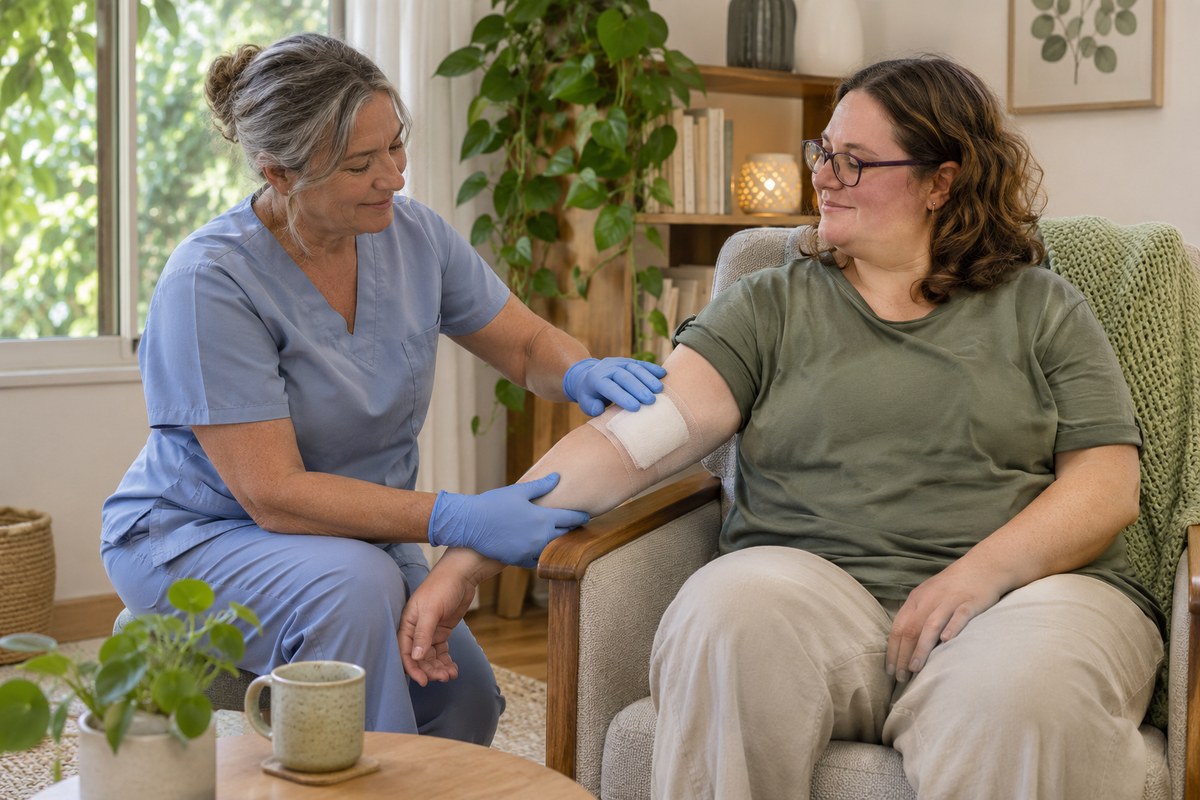
The nurse assesses the wound, chooses and changes dressings, measures healing and photographs progress with consent. For pressure injuries, the nurse also reviews seating, mattress and repositioning, because the dressing alone will not heal a wound that is still under pressure.
Catheter care and changes
Nurses change indwelling and suprapubic catheters on the schedule the treating team sets, manage blockages and bypassing, and teach workers and family what to watch for between changes.
Enteral feeding and PEG management
The nurse checks the stoma site, tube position and the participant's tolerance of the feeds, deals with granulation or leakage, and updates the feeding plan when the dietitian changes the regime.
Continence and bowel care
This includes continence assessment, bowel care plans, and the procedures that need a nurse. The nurse then decides which parts of the routine a trained support worker can carry out day to day.
Medication management
Nurses give medication that must be given by a nurse, set up and check medication routines, and review charts after any change from the GP, specialist or a hospital stay.
Clinical assessment and care planning
Every participant has a nursing assessment and a written plan for each clinical task. The plan is what support workers follow, so it is written in plain steps with clear points at which to call the nurse.
Wound reviews include the seating and mattress, not only the dressing.
What it is
Does this need a nurse or a support worker?
A nurse is needed when the task requires clinical judgement, changes from visit to visit, or is restricted to nurses. A trained support worker can carry out a stable, planned routine once a nurse has written the plan and checked the worker is competent. Most complex plans use both.
Care is led by registered nurses. Every nurse who practises in Australia must hold current registration with the Nursing and Midwifery Board of Australia, which is managed through AHPRA, and anyone can check a nurse's registration on the public register. Our nurses also hold an NDIS Worker Screening clearance.
When people ask for an NDIS registered nurse, they usually mean two things: a nurse who is registered to practise, and a provider that is registered with the NDIS Commission for nursing. We meet both. Among NDIS nursing providers, what sets a small nurse-led team apart is continuity: the nurse who wrote the plan is the one the worker calls.
Funding
How NDIS nursing is funded
Nursing is funded as a disability-related health support, usually from the Core Supports budget. The NDIA sets price limits for nursing by the nurse's qualification and the time of day. We charge within the current NDIS pricing schedule and list each item in the service agreement before the first visit.
If the plan has no nursing funding, the coordinator can request it with evidence that the need is ongoing and caused by the disability. A nursing assessment is often the strongest evidence, and we can provide one. Plan managed and self managed participants can use us, and so can participants whose plans are managed by the NDIA.
Timing
How quickly a nurse can visit
We reply to nursing enquiries within one business day. A first assessment visit is then booked for the earliest time a nurse is available in the participant's area, and urgent needs such as a discharge date are given priority. We tell you the realistic date, not the hoped-for one.
For people leaving hospital, timing is the whole point. We work with ward staff to plan a safe discharge from hospital so the first nursing visit lands when the participant gets home, not a week later.
How it works
What a first nursing visit involves
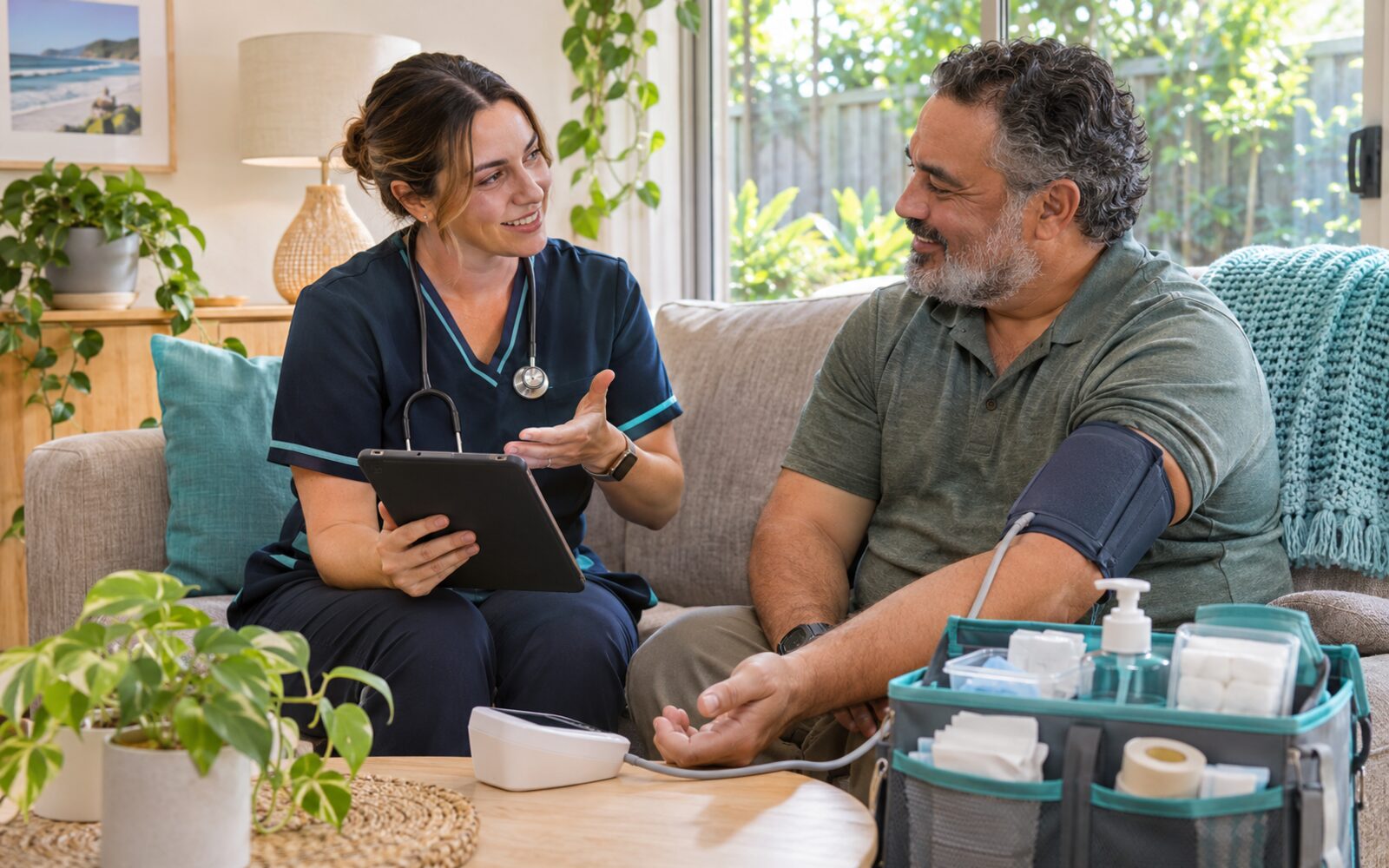
On the first visit the nurse reviews the referral and clinical documents, assesses the participant, checks equipment and supplies in the home, and agrees the plan with the participant and family. Any task that is due, such as a dressing change, is done on the day.
Before the visit. We collect the discharge summary, medication list and any orders, so the nurse arrives prepared.
Assessment. The nurse talks through health history, current routines and what the participant wants to keep doing for themselves.
Hands-on care. Any nursing care that is due is provided.
Plan and next steps. The nurse writes the care plan, sets the visit schedule and arranges training for support workers if they will share the routine.
If you would like the background first, our guide on what a community nurse does walks through a typical visit in more detail.
The plan is agreed with the participant and family on the first visit.
Safeguards
Clinical governance and what happens if something changes
Each care plan sets out what the nurse and workers will do, the signs that mean something is wrong, and who to call. If a participant's condition changes, the nurse reassesses, contacts the GP or specialist where needed and updates the plan. Emergencies go to triple zero first.
Nurses document every visit. Incidents are recorded and reviewed, and reportable incidents are notified to the NDIS Commission as required. Participants and families can raise a concern with us or with the Commission at any time.
Reviews
Care plan reviews and reporting to coordinators
Care plans are reviewed on a set schedule and after any hospital admission or change in health. After each review the coordinator receives a short written update covering what was done, what changed and whether the funded hours still match the need.
That reporting is also what supports a plan reassessment. When nursing hours need to go up or down, the notes from each review give the NDIA the evidence in one place.
Where we work
Where our community nurses visit
Our community nurses visit homes across Greater Sydney and the Perth metropolitan area. In Sydney we are based in Campbelltown, and nurses travel across the south west and west, including Liverpool and Parramatta, and further by arrangement.
Community nursing care in Sydney depends on where a nurse is rostered on a given day, so tell us the suburb and we will confirm. We have separate pages for nursing care in Sydney and nursing care in Perth. To start, make a referral or send an enquiry.
Common questions
NDIS nursing questions
Does the NDIS fund nursing care?
Yes, when the nursing need is ongoing and comes directly from the person's disability. The NDIS calls these disability-related health supports. It does not fund treatment of a health condition, which stays with the GP, hospital and Medicare.
What is the difference between a community nurse and a support worker?
A community nurse is a registered health practitioner who assesses, plans and carries out clinical care. A support worker helps with daily living and can carry out set clinical routines only after a nurse has written the plan and checked the worker is competent.
Do I need a referral for NDIS nursing?
No formal referral is needed. You, a family member or a coordinator can contact us directly. The nurse does need clinical information, such as a discharge summary and medication list, and some tasks need written orders from a GP or specialist.
Can a nurse train my support workers?
Yes. The NDIS can fund a nurse to train support workers in a participant's disability-related health supports. Our nurses train workers on the individual plan, observe them doing the task and sign them off before they work alone.
How often will the nurse visit?
It depends on the care. Dressings may need several visits a week, catheter changes follow the schedule set by the treating team, and plan reviews happen at agreed intervals. The visit schedule is written into the care plan.
Do your nurses work after hours?
Visits are booked in advance and can be scheduled outside office hours where a nurse is available. Evening and weekend visits are confirmed case by case. Our office is staffed Monday to Friday, 9 am to 5 pm, and emergencies should go to triple zero.
Which areas do your nurses cover?
Greater Sydney and the Perth metropolitan area. Sydney visits run from our Campbelltown office across the south west, west, south and inner city. Tell us the suburb and we will confirm when a nurse can attend.
Need a nurse at home under an NDIS plan?
Send us the clinical need, the suburb and any discharge paperwork. We reply within one business day with what we can do and when a nurse can visit.