Registered NDIS provider · Reg ID 4-JCLD6XENurse-led complex & clinical careServicing Sydney & PerthEnquiries answered same business dayRegistered NDIS provider · Reg ID 4-JCLD6XENurse-led complex & clinical careServicing Sydney & PerthEnquiries answered same business day
Clinical Capabilities: Complex Care Nursing Tasks We Deliver
A plain list of the clinical tasks we take on, who does each one, and what we do not do.
This page sets out the complex care nursing tasks Abundance Healthcare Group delivers at home in Sydney and Perth. It is written for support coordinators and discharge planners who need to know, before they call, whether a participant can be placed with us.
What it is
The clinical tasks we are registered and trained to deliver
We deliver seven clinical task areas: complex bowel care, enteral feeding, urinary catheter care, subcutaneous injections, complex and chronic wound care, severe dysphagia management and medication management. Each is delivered by a nurse or by a support worker trained on that task under a nurse's plan.
Six of these are high intensity supports under the NDIS Commission's practice standards. Medication management runs across all of them.
Complex bowel care
Enemas, suppositories and digital stimulation on a planned routine, with results recorded and changes reported the same day. For referrers looking for bowel care NDIS providers, we need the current bowel plan or the treating team's instructions.
Enteral feeding (PEG)
Feeds, flushes, medication through the tube and daily stoma site care. If you are placing a participant who needs PEG feeding, NDIS evidence should include the dietitian's regime, which our workers follow exactly.
Urinary catheter care
Daily care of indwelling and suprapubic catheters and drainage bags by trained workers, with catheter changes done by a nurse. Catheter care under the NDIS is split this way because insertion is a nursing procedure.
Subcutaneous injections
Prescribed injections set up under a medication plan, most often insulin. Workers check the dose against the plan, rotate sites and record every injection.
Complex and chronic wound care
A nurse assesses and dresses the wound and reviews seating and pressure relief. Trained workers carry out repositioning and skin checks between visits. Complex wound care is always nurse-led.
Severe dysphagia management
Texture modified meals and thickened fluids prepared to the speech pathologist's mealtime plan, correct positioning, paced eating and a clear response to coughing or choking.
Medication management
Nurses give nurse-only medication and review charts after any change. Trained workers prompt or assist with packed medication and report missed or refused doses. Medication management under the NDIS is funded only where the need relates to the disability.
Each clinical task has a written plan the worker follows step by step.
What it is
Which tasks need a registered nurse?
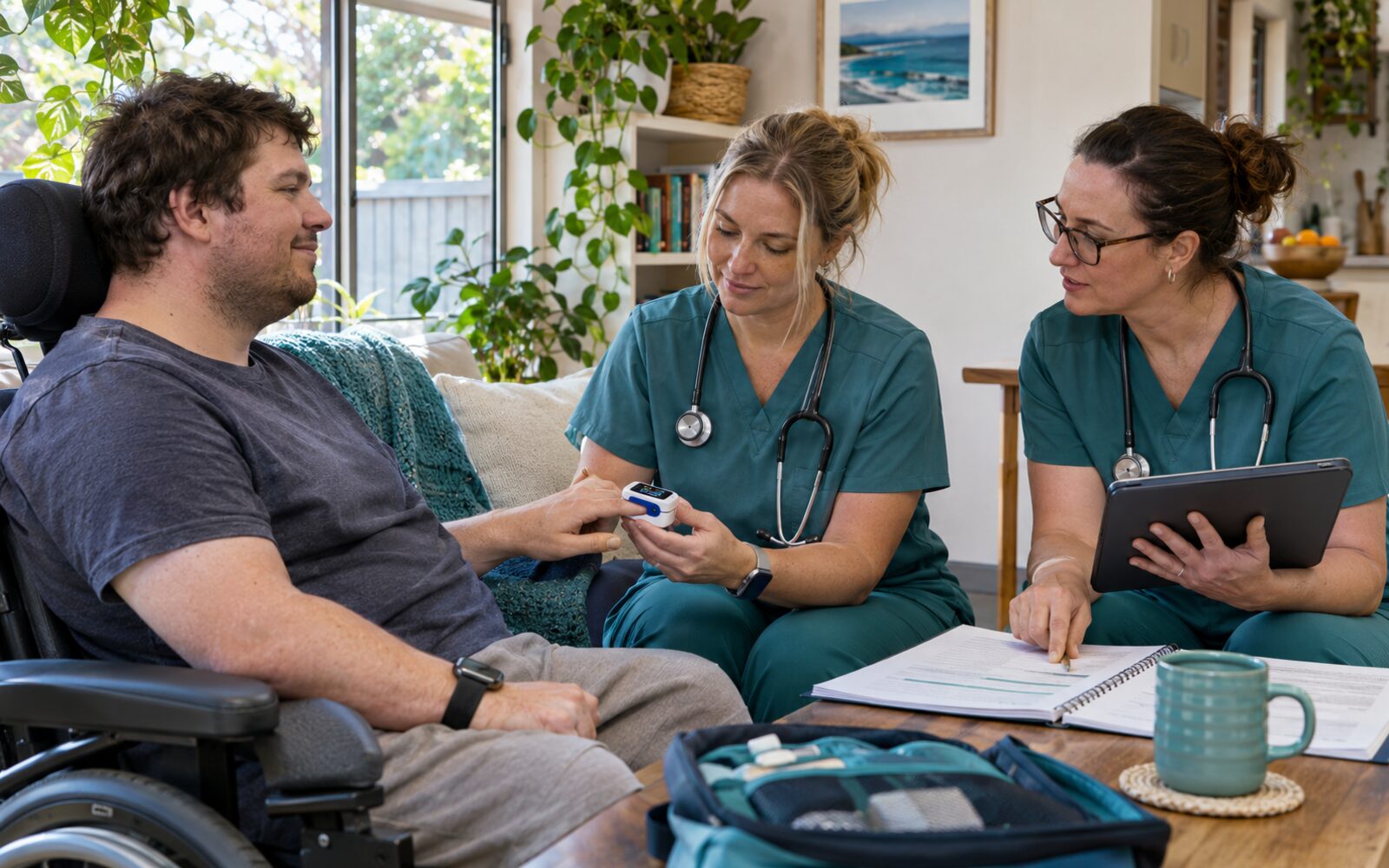
A registered nurse is needed for assessment, for procedures restricted to nurses and for any task that changes from day to day. A trained support worker can carry out a stable routine once the nurse has written the plan and signed the worker off. The matrix shows who does what.
Clinical task
Delivered by
Oversight
Registration group
Bowel care routine
Trained support worker
Nurse's plan, results recorded each time
0104
PEG feeds, flushes and site care
Trained support worker
Nurse's plan and dietitian's regime
0104
PEG site review, tube problems
Registered nurse
Treating team
0114
Daily catheter and bag care
Trained support worker
Nurse's plan
0104
Catheter change
Registered nurse
Treating team's schedule
0114
Set subcutaneous injection
Trained support worker
Medication plan, nurse sign off
0104
Wound assessment and dressing
Registered or enrolled nurse
Orders where required
0114
Pressure care between visits
Trained support worker
Nurse's plan
0104
Mealtime support for severe dysphagia
Trained support worker
Speech pathologist's mealtime plan
0104
Nurse-only medication
Registered or enrolled nurse
Prescriber's orders
0114
Nursing tasks are delivered as NDIS community nursing care. Group 0104 is Assist Personal Activities High and group 0114 is Community Nursing Care.
Who delivers it
How competency is assessed and kept current
A registered nurse trains each worker on the task and on the individual participant's plan, watches the worker perform it, and signs them off before they work alone. Competency is reviewed at set intervals and again whenever the plan changes or the worker has not done the task for some time.
This follows the NDIS Commission's high intensity support skills descriptors, which recommend a yearly review and a reassessment after three months without delivering the support. Sign off is recorded per worker, per task, per participant.
What it is
What we do not deliver
We do not provide tracheostomy care or ventilator support, including day to day support for non-invasive ventilation as a high intensity task. We do not write behaviour support plans, prescribe medication or provide hospital-level or acute care. We say so at the first conversation.
If a participant needs one of these alongside supports we do deliver, tell us. Sometimes a shared arrangement with another provider works, and sometimes the safer answer is that we are not the right fit.
Safeguards
Restrictive practices: only as authorised in a behaviour support plan
We do not start, suggest or use a restrictive practice on our own judgement. A regulated restrictive practice may only be used when it is written into a behaviour support plan by a registered behaviour support practitioner, authorised under state or territory rules, and reported to the NDIS Commission.
The regulated practices are seclusion and chemical, mechanical, physical and environmental restraint. If a referral includes any of them, send the behaviour support plan and the authorisation with it. We review each such referral individually before accepting.
Funding
Funding and the registration group each task sits under
Tasks done by trained support workers are funded from Core Supports at the high intensity price limit, under group 0104. Tasks done by a nurse are funded as disability-related health supports at nursing price limits, under group 0114. We charge within the NDIA's current pricing schedule.
A participant who needs both will see both on the service agreement, itemised. Where the plan has no clinical funding yet, our nursing assessment can support a reassessment request.
Timing
How fast we confirm capability for a referral
We confirm capability and capacity within one business day of receiving the clinical detail. The answer is a yes, a no, or a yes with a start date. For complex nursing care that depends on overnight staffing, we confirm case by case and explain what the limit is.
How it works
What referrers send us and what they get back
Referrers send the tasks and their frequency, the suburb, the plan dates and any clinical documents. In return they get a written capability answer, a nurse's assessment, a costed roster and a short report after every review.
Referral. Coordinators and planners can refer a participant with documents attached.
Capability answer. Within one business day, in writing.
Nurse assessment. At home or on the ward, with plans written for each task.
Roster and agreement. Itemised by support and registration group.
Reporting. A written update after each review and after any incident.
Sign off is recorded per worker, per task, per participant.
Reviews
Clinical governance, escalation and review
A registered nurse is accountable for every clinical plan. Plans state the steps, the warning signs and who to call. Workers escalate to the nurse, the treating team or triple zero as the plan directs. Incidents are recorded, reviewed and reported to the NDIS Commission where required.
Plans are reviewed on a schedule and after any hospital admission. Clinical nursing care is only as safe as its last review, so a change in the participant's health triggers a review without waiting for the date.
Where we work
Where these capabilities are available
These capabilities are available in participants' homes across Greater Sydney and the Perth metropolitan area. Because each task needs trained workers near the participant, we confirm availability by suburb before accepting a referral.
Common questions
Clinical capability questions
Can support workers do PEG feeding?
Yes, when they are trained on enteral feeding and on the participant's own plan, and a nurse has signed them off. The worker gives feeds, flushes and site care. Changes to the regime and tube problems go to the nurse and dietitian.
Who can change a catheter under the NDIS?
A nurse. Inserting or changing an indwelling or suprapubic catheter is a nursing procedure. A trained support worker looks after the catheter and drainage bags between changes and reports signs of blockage or infection.
Do you provide tracheostomy or ventilator support?
No. We do not currently provide tracheostomy care or ventilator support. If a participant needs either, tell us at referral so we can be clear about what we can cover and what another provider would need to deliver.
Can support workers give medication?
Trained workers can prompt and assist with medication that has been packed by a pharmacist, under a medication plan, and can give a set subcutaneous injection after sign off. Medication that must be given by a nurse is given by a nurse.
Do you implement restrictive practices?
Only where a practice is written into a current behaviour support plan, properly authorised and reportable to the NDIS Commission. We review every referral that involves a restrictive practice before accepting it, and we never introduce one ourselves.
How do you prove a worker is competent for a task?
A registered nurse observes the worker performing the task on the participant's own plan and records the sign off. The record shows the worker, the task, the participant and the date, and it is renewed at each competency review.
Can we see a capability statement?
Yes. This page is our capability statement in web form. If you need it in writing for your records, ask when you refer and we will confirm our capability for that participant by email.
Have a participant with clinical needs to place?
Send the tasks, their frequency and the suburb. A registered nurse reviews it and we confirm capability and capacity within one business day.