Registered NDIS provider · Reg ID 4-JCLD6XENurse-led complex & clinical careServicing Sydney & PerthEnquiries answered same business dayRegistered NDIS provider · Reg ID 4-JCLD6XENurse-led complex & clinical careServicing Sydney & PerthEnquiries answered same business day
NDIS Provider in Fairfield with Culturally Matched Care
Care is safer when the person receiving it and the person giving it understand each other.
Fairfield is one of the most linguistically diverse parts of Australia, and complex care depends on clear communication. Abundance Healthcare Group asks every Fairfield family which language, food and customs matter, matches a trained worker where one is available, and brings in an interpreter when a decision about care has to be fully understood.
What it is
Complex NDIS care in Fairfield, in your language where we can
We provide complex NDIS care in Fairfield for people who need clinical tasks at home, and we try to provide it in the participant's own language. Where a trained worker who speaks that language is available, we roster them. Where one is not, we say so and plan communication another way.
Families comparing NDIS providers in Fairfield should ask each one the same thing: what happens when my mother cannot explain that something hurts? Our answer is on this page. We also work as an NDIS provider in Cabramatta, Canley Vale and Bonnyrigg. For the wider region, see South West Sydney.
What we deliver
Supports for Fairfield households
Fairfield households can use four supports: high intensity daily personal activities, community nursing, daily personal care, and community access and transport. Each is planned with the family, because in most homes here relatives are closely involved in care and in decisions.
High intensity daily personal activities
Clinical routines such as tube feeds, bowel care and catheter care, done by trained workers to a nurse's written plan. The plan can be explained to the family through an interpreter.
Community nursing at home
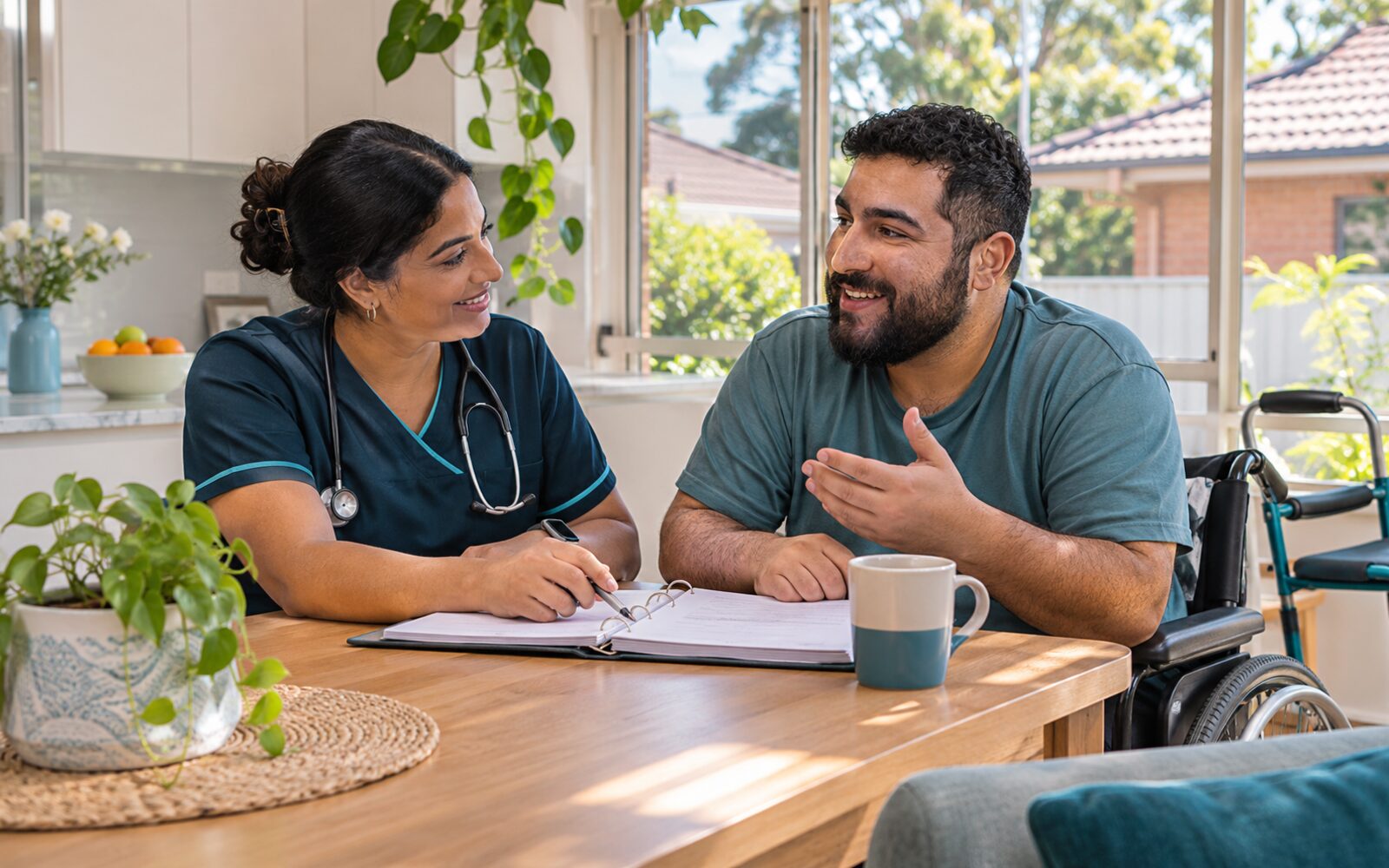
When a nurse at home is needed, the nurse explains each step before doing it and checks that the explanation has been understood.
Daily personal care
Everyday personal care at home covers showering, dressing and meals. Food preferences, modesty and who may be present are asked about first and written down.
Community access and transport
Temple, church or mosque, the Cabramatta shops, community clubs and medical appointments, with a worker who can help with conversation where language is a barrier.
We ask about language, food and customs before the first shift.
Who delivers it
Language, food and faith: how matching works
Matching starts with questions, not assumptions. We ask which language the participant is most comfortable in, what they eat and do not eat, any religious practice that affects the day, and whether the gender of the worker matters. The answers go into the plan that every worker reads.
We do not publish a list of languages our workers speak. Teams change, and a promise we cannot keep on every shift is worse than no promise. People from many backgrounds use our service, and you can read more about who we support.
Local support
Fairfield Hospital and community health links
Fairfield Hospital at Prairiewood is the local public hospital, within the South Western Sydney health district. Hospitals provide interpreters for their own appointments. When someone is discharged, we make sure the instructions given on the ward have been understood at home as well.
A discharge summary written in English is of limited use to a family that does not read it. Our nurse goes through it with the family, with an interpreter if needed, and turns it into a plan in plain steps. The hospital is named for geography, and we have no formal arrangement with it.
What it is
Interpreter, bilingual worker or family: who helps when?
Different situations call for different help. A bilingual worker is ideal for everyday care. A professional interpreter is the right choice for consent, care planning and anything clinical or legal. Family can help with daily conversation but should not be relied on to interpret medical decisions.
Situation
Best option
Who arranges it
Day to day conversation during a shift
Bilingual worker, where one is available
We do, at rostering
Explaining a care plan or a change to it
Professional interpreter
We do
Consent to share information or start a service
Professional interpreter
We do
Signing the service agreement
Professional interpreter, with a plain English copy
We do
Hospital or specialist appointment
The hospital's own interpreter service
The hospital, on request
A quick practical question
Family member, if the participant agrees
The family
Funding
NDIS budgets explained simply
An NDIS plan is a budget for supports. Our services are paid from it, within prices set by the NDIA, and you are not charged extra. Before anything starts, we give you a service agreement that lists each support and its cost, and we explain it with an interpreter if needed.
For families new to the NDIS, Fairfield has local area coordinators who help people understand and use a plan. A support coordinator, if the plan funds one, can do the same. We are happy to explain our part to either.
How it works
Meeting us and starting
We start with a conversation, in your language where possible. A nurse then visits the home to assess, and the family can be present throughout. Plans are written, the agreement is signed and workers are trained before the first shift. We reply to every enquiry within one business day.
Contact. You, a relative or a coordinator can talk to us through the enquiry form.
First conversation. We ask about the supports, the language and what matters at home.
Nurse visit. The assessment takes place at home, with an interpreter if needed.
Agreement. The service agreement is explained before it is signed.
First shifts. Workers are introduced to the family before working alone.
Safeguards
Speaking up if something is wrong
You can complain in your own language. Tell any worker, tell the nurse or contact our office, and we will arrange an interpreter. You can also go directly to the NDIS Quality and Safeguards Commission, which takes complaints through interpreters. Raising a concern never affects the care you receive.
We are a registered NDIS provider, Registration ID 4-JCLD6XE. Workers hold an NDIS Worker Screening clearance, incidents are recorded and reviewed, and plans are reviewed after every hospital stay.
Local support
Recent support in Fairfield
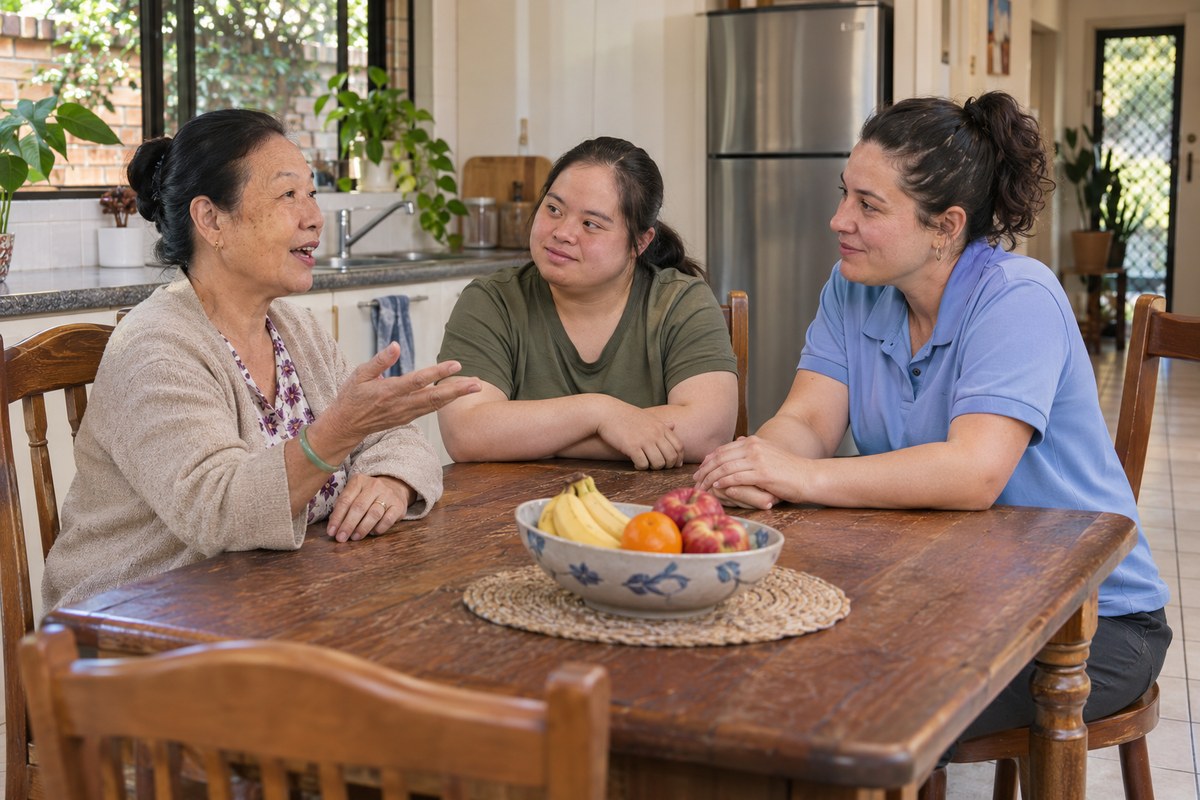
Everyday support in Fairfield households, shown with permission. Consent is explained in the family's language before a photograph is taken, written down, and can be withdrawn later. Faces and addresses are left out.
Where we work
Cabramatta, Bonnyrigg and nearby suburbs
We take referrals across Fairfield City: Fairfield, Fairfield West, Fairfield Heights, Cabramatta, Canley Vale, Canley Heights, Bonnyrigg, St Johns Park, Edensor Park, Bossley Park, Prairiewood, Wetherill Park, Smithfield and Carramar. The area is close to our Campbelltown office.
Fairfield disability services are spread across several town centres, so tell us the suburb. Immediately south, we also support people in Liverpool.
Common questions
Fairfield NDIS questions
Which languages do your workers speak?
It changes as the team changes, so we do not publish a list. Tell us the language you need. We check for a trained worker who speaks it and give you a clear yes or no before you commit to anything.
Can I ask for a worker from my community?
Yes, you can ask, and we will try. Some people prefer the opposite, for privacy, and that is respected too. Either way the worker must be trained and signed off on the participant's plan.
Do you use interpreters for care planning?
Yes. Care plans, consent and the service agreement are explained through a professional interpreter when the participant or family needs one. Relatives are not asked to interpret clinical decisions.
Do you cover Cabramatta and Canley Vale?
Yes. Both are in Fairfield City and inside our service area. They are a short drive from our Campbelltown office, which generally makes rosters easier to staff.
Can my family be involved in decisions?
Yes, if the participant wants them involved. We ask the participant first, record who may be told what, and include those relatives in assessments, training and reviews.
Is the service agreement available in plain English?
Yes. The agreement is written in plain English, and we go through it with an interpreter where needed before anyone signs. You can take it away and ask someone you trust to read it first.
Looking for complex care in your own language?
Tell us the suburb, the language and the supports needed. We reply within one business day and say plainly whether we can match.