


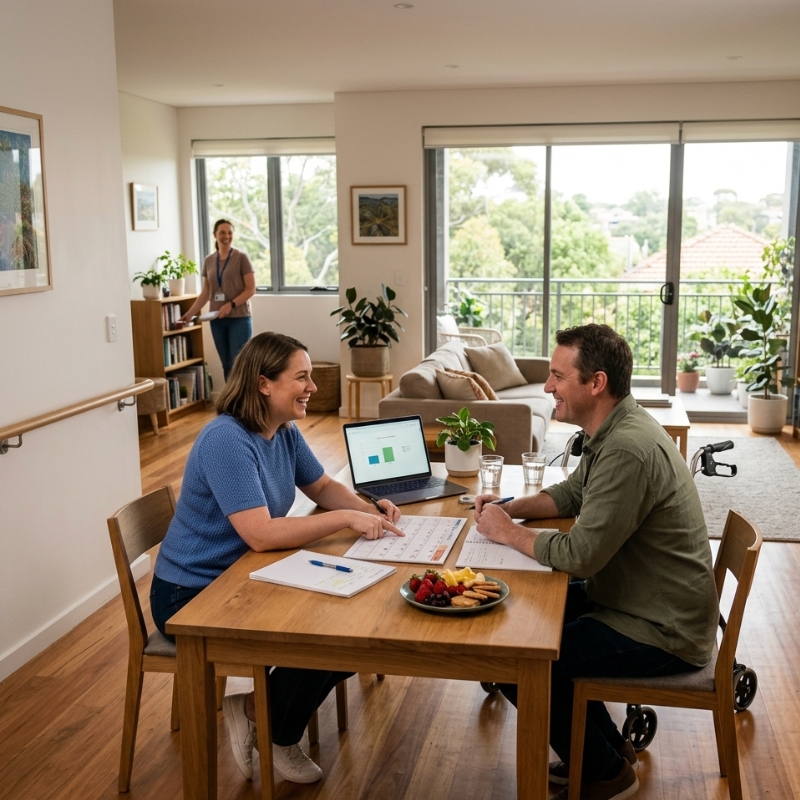
Supported Independent Living (SIL) can feel like one of the most confusing “home and living” terms in the NDIS world—especially when people use SIL, SDA, group homes, and “supported accommodation” as if they all mean the same thing. In Sydney, where housing, transport, and day-to-day routines can look very different suburb to suburb, getting clear on the basics of SIL and how it fits within broader disability support (and knowing what to ask) makes a huge difference.
This guide breaks SIL down in plain English, then gives you a practical way to compare options so you can choose a setup that supports safety, independence, and real-life comfort—not just a nice brochure.
What Supported Independent Living actually is
SIL is a type of NDIS support that helps a participant live in their home by providing help or supervision with daily tasks. That might include things like personal care, meal preparation, cooking, household tasks, or day-to-day prompts and oversight, depending on the person’s needs and goals. For the clearest participant-friendly explanation, the NDIS overview is a solid reference: NDIS — Supported independent living for participants.
The key idea: SIL is the support, not the building.
A participant can receive SIL in different living arrangements, including shared homes, and the specifics should reflect the participant’s support needs—not a generic package.
Quick answer
If you strip it back, SIL is about having the right level of support in the place you live so daily life is safe, consistent, and as independent as possible.
Q&A
Is SIL “housing”?
Not by itself. SIL refers to the support delivered in the home. The housing itself might be a private rental, social housing, a family home, or another arrangement.
Is SIL always a shared living?
Often it is, but SIL is ultimately about support needs. The living arrangement depends on what’s reasonable and necessary in the plan and what the participant wants.
What SIL can include in day-to-day life
SIL is commonly used when a participant needs frequent support across the day, evenings, or overnight. In practice, supports can include:
• Morning routines (showering, dressing, prompts, mobility support)
• Meal planning and cooking (support to prepare meals safely, build skills, or follow dietary needs)
• Household routines (laundry, cleaning, shopping support)
• Medication prompts (where appropriate and within the agreed role of the worker)
• Building independent living skills (budgeting, cooking skills, using public transport with the right supports)
• Support with communication, routines, or behaviour support strategies (where a behaviour support plan exists)
• Overnight support models (sleepover, active overnight, or on-call, depending on needs)
SIL should be tailored: two people in the same house can have very different support hours and support types.
Q&A
Does SIL cover community access like going to the shops or appointments?
Sometimes, if it’s part of the daily living routine and aligns with goals. The exact inclusion depends on the plan and the support being delivered.
Does SIL mean 24/7 staff are always in the home?
Not always. Some people need 24/7 presence. Others need drop-in support at set times, plus a clear escalation plan for emergencies.
Who supported the Independent Living suits best
SIL is usually considered when someone needs significant help with daily tasks and benefits from a consistent support environment. It can suit participants who:
• Need regular support across most days (not just a few hours a week)
• Have safety risks without supervision (for example, seizures, night-time wandering, or high support needs)
• Need a stable routine and trained workers to implement strategies consistently
• Want to build independent living skills in a supported environment
• Benefit from shared living (companionship, shared routines, shared supports) when compatibility is right
It may be less suitable when a participant’s needs are low-to-moderate and can be met with more flexible in-home supports, or when shared living is likely to create stress due to sensory needs, trauma history, or incompatibility—unless strong safeguards and careful matching are in place.
Sydney-specific lens: the “real life” fit
In Sydney, “fit” isn’t just about the house. It’s also about:
• Distance to family and meaningful relationships (important for maintaining routine and wellbeing)
• Access to public transport that works for the participant (train stations with lifts, bus routes, safe walking paths)
• Proximity to day programs, work, allied health, community groups, and favourite places
• The suburb’s noise level, crowds, and sensory load (huge for some participants)
SIL vs SDA: the difference that saves a lot of stress
SIL and SDA are often talked about together because people may have both. But they are different parts of the system:
• SIL = the supports (help/supervision with daily tasks)
• SDA = the home’s design/build features for eligible participants (the physical housing)
A participant can have SIL without SDA, SDA without SIL, or both together—depending on needs and the plan.
Q&A
If a place advertises “SIL vacancies”, what are they really offering?
Usually, they’re talking about a living arrangement where SIL supports can be delivered. It still matters to confirm the support model, staffing, and how participant choice works.
If the house is perfect, does that mean the support will be?
Not necessarily. A great building can still have poor routines, weak handovers, or a mismatch in housemate dynamics. Treat housing and support quality as two separate checks.
The “roster of care” explained in plain English
You’ll hear the term roster of care when SIL supports are being planned, reviewed, or described. Think of it as a structured, practical description of what support happens when—morning routines, meal times, evenings, and overnight—so everyone is clear about day-to-day expectations.
To make it real, a roster of care answers questions like:
• Who is there on weekday mornings?
• What support is provided at meal times?
• Is there active support overnight, a sleepover, or on-call support?
• What happens during shift changes (handover)?
• How are incidents escalated and documented?
Q&A
Why does this matter to families and participants?
Because “SIL support” can sound vague. The roster makes the day-to-day visible. It helps you compare two options that both claim to provide “high support” but actually staff very differently.
How to compare SIL options in Sydney without getting overwhelmed
It helps to compare SIL using a repeatable framework. Here’s a practical way to do it.
1) Start with outcomes, not the brochure
Before you inspect houses, write down:
• The participant’s daily routine (morning, afternoon, evening, overnight)
• What needs support vs what the participant wants to do independently
• Non-negotiables (privacy, quiet, accessibility needs, pet preferences, visitor rules, cultural needs)
• Triggers and supports that work (communication methods, calming strategies, sensory supports)
If you want a helpful way to organise that thinking, start by mapping the participant’s day against the kinds of supports that fall under home and living—this is where it can help to understand home and living supports before you compare any houses or providers.
2) Get specific about staffing (and don’t accept vague answers)
Ask each option:
• What is the staffing model across a week (including weekends)?
• Is support active, on-call, or sleepover overnight?
• What happens if a worker calls in sick?
• How are workers trained for the participant’s specific needs?
• How are shift handovers done (written logs, verbal handover, both)?
• Who is the escalation contact after hours?
Red flag: lots of “it depends” without explaining the decision-making process.
3) Check housemate compatibility and routines
Shared living only works when compatibility is treated as essential, not optional. Ask:
• How are housemates matched?
• What are the common routines (meals, shared spaces, quiet times)?
• How are conflicts handled?
• What privacy does each person have (bedroom locks, personal storage, quiet spaces)?
• What is the approach to visitors, family involvement, and community participation?
Sydney reality check: parking, public transport, and travel time matter. A house that is “close” on a map can still be exhausting if it requires multiple transfers or long walks in heat, rain, or crowded areas.
4) Look for transparent safeguards and incident culture
You want a home where safety is routine, not reactive. A good comparison set of questions includes:
• How are incidents documented and communicated to the participant/nominee?
• What’s the provider’s incident management process in practice (not just policy)?
• How are risks identified and reviewed over time?
• If behaviour support is involved, how is the behaviour support plan implemented consistently?
• How does the provider approach consent, privacy, and dignity in daily routines?
A simple rule of thumb: if the provider can’t explain their safeguards clearly and calmly, keep looking.
5) Test “choice and control” in everyday decisions
Choice and control aren’t just slogans. It shows up in small things:
• Can the participant choose meal preferences and routines?
• Can they choose who supports them where possible?
• Is communication accessible (Easy Read, visual supports, interpreters if needed)?
• Are they involved in house meetings, planning, and feedback?
When you’re comparing two options that look similar on paper, the deciding factor is often whether the household genuinely supports autonomy—so keep coming back to what it means to support choice and control at home in real, daily decisions.
6) Ask for evidence of quality (not just claims)
Instead of “we’re great,” ask for:
• Examples of how independence goals are built into daily routines
• How progress is tracked (skill-building, routines, participation)
• How families/guardians are involved (with the participant’s consent)
• How the provider supports transitions (moving in, changing housemates, stepping down/up supports)
7) Understand the agreement and responsibilities
Before anyone moves:
• What is included in SIL supports vs what is not?
• What are the house rules and how are they agreed?
• How are costs handled (utilities, food, shared items) and who manages them?
• What happens if the arrangement isn’t working?
This is also the moment to clarify who to contact for plan issues, reviews, or changes, and what documentation helps.
Common mistakes people make when comparing SIL
Mistake 1: Choosing based on the house alone
A renovated kitchen won’t fix poor handovers, inconsistent routines, or mismatched housemates. Always evaluate housing and support separately.
Mistake 2: Not asking about “worst day” scenarios
Ask:
• What happens if there’s a medical issue at 2 am?
• Who decides whether to call family, ambulance, or on-call staff?
• How is information documented and shared?
Mistake 3: Assuming “shared support” automatically reduces risk
Shared support can work brilliantly when compatibility and routines are right. It can also increase stress if housemates are mismatched or boundaries aren’t respected.
Mistake 4: Skipping the transition plan
Moving is disruptive. Ask for a step-by-step transition plan that covers:
• Getting to know workers
• Trial visits or overnight stays where possible
• Routine mapping
• Communication supports
• Risk assessment updates
Mini-scenarios: Is SIL the right fit?
Scenario 1: “I’m safe at home, but I can’t manage meals and routines”
If the main issue is routines and household tasks, SIL might be too intensive. A flexible in-home support setup could be enough—unless there are safety risks or consistent supervision needs.
Scenario 2: “I need support throughout the day and night”
SIL is often considered when support needs aren’t limited to set daytime hours, and consistency is important for safety and well-being.
Scenario 3: “I want independence, but I’m isolated”
SIL in a well-matched shared home can support both independence and connection—if the house culture supports participation rather than passive care.
Scenario 4: “Shared living sounds stressful”
That’s valid. Sensory needs, trauma history, or a strong preference for solitude can make shared living hard. The comparison process should include quiet spaces, privacy, visitor boundaries, and de-escalation strategies—plus honest conversations about whether another arrangement would better support wellbeing.
What to do if a SIL arrangement isn’t working
Even with careful planning, sometimes things don’t fit. If you’re seeing issues like rising anxiety, reduced participation, frequent incidents, or ongoing conflict, treat it as a signal to act early.
Practical steps:
• Document what’s happening (dates, patterns, triggers, what support was provided)
• Ask for a meeting focused on outcomes and safety, not blame
• Request changes to routines, staffing, or compatibility supports
• Consider whether the living arrangement needs to change
• If plan funding or support intensity no longer matches needs, speak with your coordinator/plan supports about next steps for evidence and review
If you’re building a clearer picture of supports and next steps, it can also help to explore broader guidance around disability support for NDIS participants, so you’re comparing SIL options with the full context in mind.
Final FAQs
What is Supported Independent Living (SIL) under the NDIS?
SIL is an NDIS support that provides help or supervision with daily tasks so a participant can live as independently as possible in their home. For a participant-friendly definition, see: NDIS — Supported independent living for participants.
Is SIL the same as a group home?
Not necessarily. SIL can be delivered in different living arrangements, and the support model should be tailored. Some SIL setups look like traditional shared living, but the focus should remain on participant goals, routines, and choice.
How is SIL different from SDA?
SIL is the support delivered in the home. SDA relates to the physical home’s design features for eligible participants. Some people have one, some have the other, and some have both.
What should I ask when comparing SIL providers in Sydney?
Ask about staffing across a full week, overnight support model, sick-call coverage, handovers, escalation pathways, housemate matching, privacy, visitor rules, and how incidents are documented and communicated.
What is a roster of care?
A roster of care is a structured description of what supports are delivered when (across mornings, afternoons, evenings, and overnight), so the day-to-day support is clear and can be compared across options.
What are red flags when inspecting a SIL option?
Common red flags include vague staffing answers, unclear overnight support, poor transparency about incidents and communication, weak housemate matching, and a lack of participant involvement in everyday decisions.

